You remember the exact moment you stopped recognizing your own body.
Maybe it was the scale. You hadn't changed anything. Same meals. Same walks. Same everything. But the weight had moved anyway, all of it settling somewhere new, like your body had made a quiet decision without consulting you.
Maybe it was mid-sentence. The word you needed just wasn't there. Not on the tip of your tongue. Gone. You smiled through it. Nobody noticed but you.
Maybe it was the hair. You stopped counting what came out in the shower because counting made it feel too real.
Or maybe it was something harder to name. A flatness. Like someone turned the brightness down on everything and you couldn't find the dial.
You did everything right.
The selenium. The zinc. The iodine. Copper because you'd learned most stacks left it out and failed because of it. You built the protocol carefully. You took it every morning without missing a day.
So why are you still waking up at 3 a.m. soaking wet, lying there in the dark, wondering why nothing is working?
You brought all of it to your doctor. The weight. The exhaustion that sleep doesn't fix. The fog. The hair. The hands that are cold in July. The mood that arrives from nowhere and has nowhere to go.
She ran the panel. Called you a few days later.
Everything was normal.
Stress, maybe. Age, possibly. Try to manage it. Get more sleep.
You drove home and sat in the driveway.
Normal.
But you didn't stop there.
You kept reading. You stayed up too late going down research rabbit holes your doctor had never mentioned. You found communities of women who sounded exactly like you. You started connecting dots nobody had connected for you.
And eventually you landed on something that finally made the whole picture make sense.
Your thyroid.
Not a dramatic failure. Not a number so far out of range that any doctor would catch it. Something subtler.
Here's what you figured out:
Your thyroid doesn't produce the hormone your cells actually use. It produces T4 — raw, inactive, a storage form. Before a single cell in your body can use it for energy, metabolism, mood, hair growth, temperature regulation, weight — your body has to convert that T4 into T3. Active hormone. The signal that tells every cell what to do.
That conversion requires four specific minerals. Selenium. Zinc. Iodine. Copper.
Without them the conversion stalls. T4 accumulates in its inactive form. Your thyroid keeps producing and nothing happens downstream. You get every symptom of low thyroid function while your labs show a normal TSH — because your doctor tested production. Nobody tested conversion.
You understood this. You found the minerals. You built the protocol. Selenium because you read the studies. Zinc in the right form because you knew zinc oxide was useless. Iodine in the right dose. Copper because you'd learned most stacks left it out and failed because of it.
You did everything right.
And you still woke up at 3 a.m. wondering why nothing was working.
I know that feeling.
Not the tired kind of knowing. The specific kind. The kind where you've done the reading, found the answer, done everything the answer told you to do — and you're still lying there with your heart hammering and your shirt soaked through and the ceiling looking back at you with nothing to offer.
That specific defeat.
The exhaustion of being right about what's wrong with you — and still not being able to fix it.
I spent two years inside that feeling.
And the answer, when I finally found it, wasn't a new mineral. It wasn't a different protocol. It wasn't something the thyroid community had missed.
It was something so simple and so maddening that I sat with it for a long time before I could say it out loud.
The minerals were right.
The problem is that…
90% of supplements never reach your thyroid. So you never feel the difference.
Here's why — and it matters more than anything else you've read about your thyroid.
When you swallow a selenium capsule, your body doesn't just absorb it.
It has to survive it first.
That capsule hits your stomach. Acid starts breaking it down immediately. Whatever survives moves into your small intestine where digestive enzymes go to work on what's left. Whatever fraction makes it through the intestinal wall enters your bloodstream — depleted, fragmented, competing with everything else for transport.
And then from there it has to travel to your thyroid.
Which sits at the base of your neck.
That is a long, brutal journey for a mineral particle that started dissolving the moment it left your mouth.
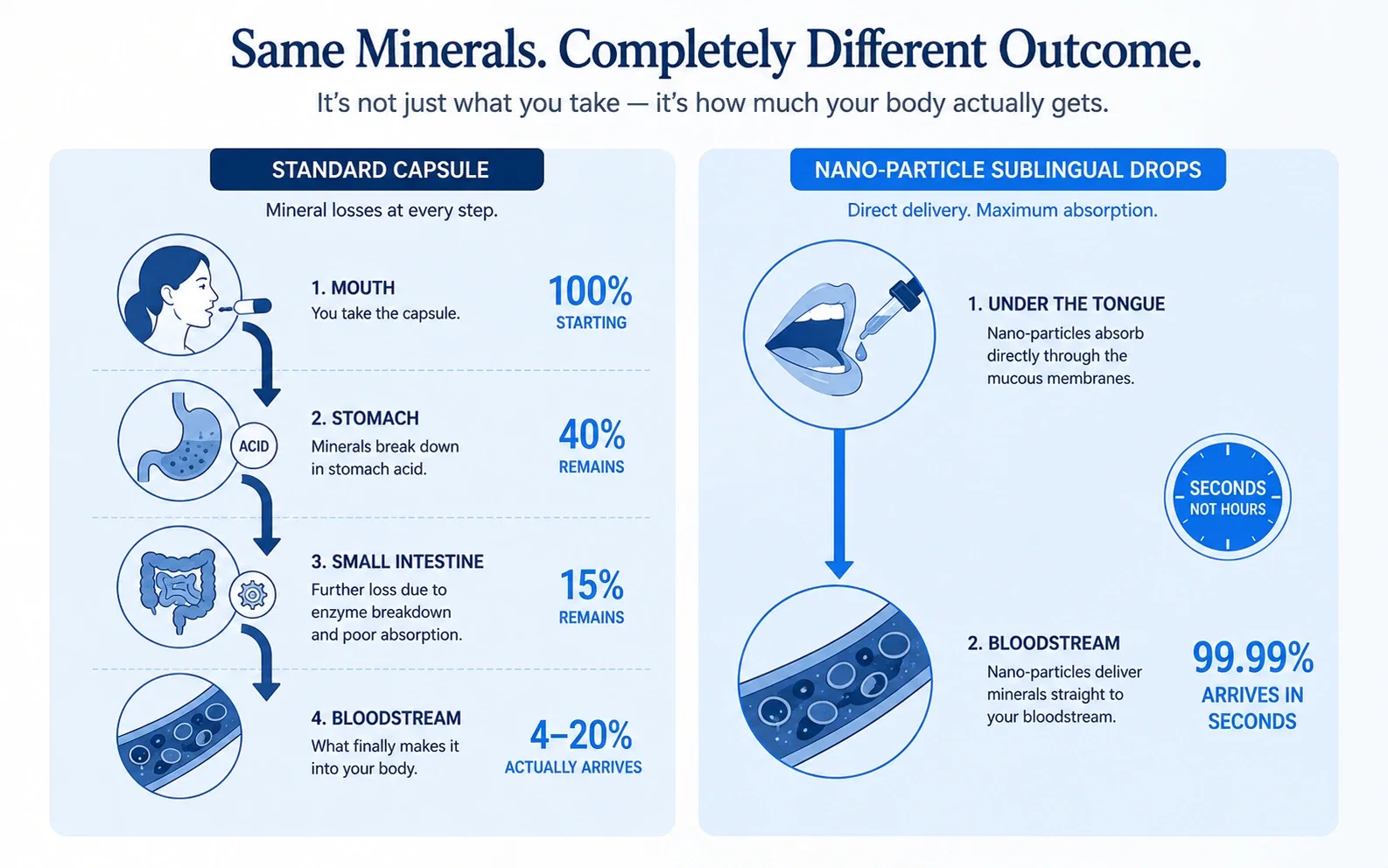
Two paths for the same mineral. Only one arrives.
First, I want you to think about what it cost you to get here.
Not just the money, though that's real — the bottles, the brands, the stacks you built and rebuilt every time something didn't work. I mean what it cost you in something harder to replace.
Hope.
The specific hope that comes from finally understanding what's wrong with you and believing that now — now that you know — you can fix it. The hope you felt the first morning you opened the right supplement and thought: this is it. This is finally the thing.
You weren't wrong to hope.
The research was right. The mechanism was right. The minerals were right.
The form was wrong. And nobody told you that.
Not the communities you trusted. Not the practitioners you paid. Not the brands whose labels you read line by line in the supplement aisle.
Nobody said: by the way, most of what you're swallowing isn't reaching the place it needs to go.
That silence cost you two years.
There is another way in.
Nano-particle technology changes everything about how these minerals reach your thyroid.
The same four minerals your research pointed you to — selenium, zinc, iodine, copper — reduced to particles small enough to absorb directly under the tongue. Into your bloodstream in seconds. No stomach acid. No digestive enzymes. No intestinal wall. Nothing lost.
Absorption rate: 99.99%.
Not 4%. Not 20%. The full amount. Every dose. Reaching the conversion pathway that has been waiting for it.
This is not a new mineral. Not a new mechanism. You already know the mechanism. You already identified what your thyroid needs. That research wasn't wrong and you weren't wrong to trust it.
The only thing that was wrong was the form.
90% of supplements are in the wrong form. I found one that isn't.
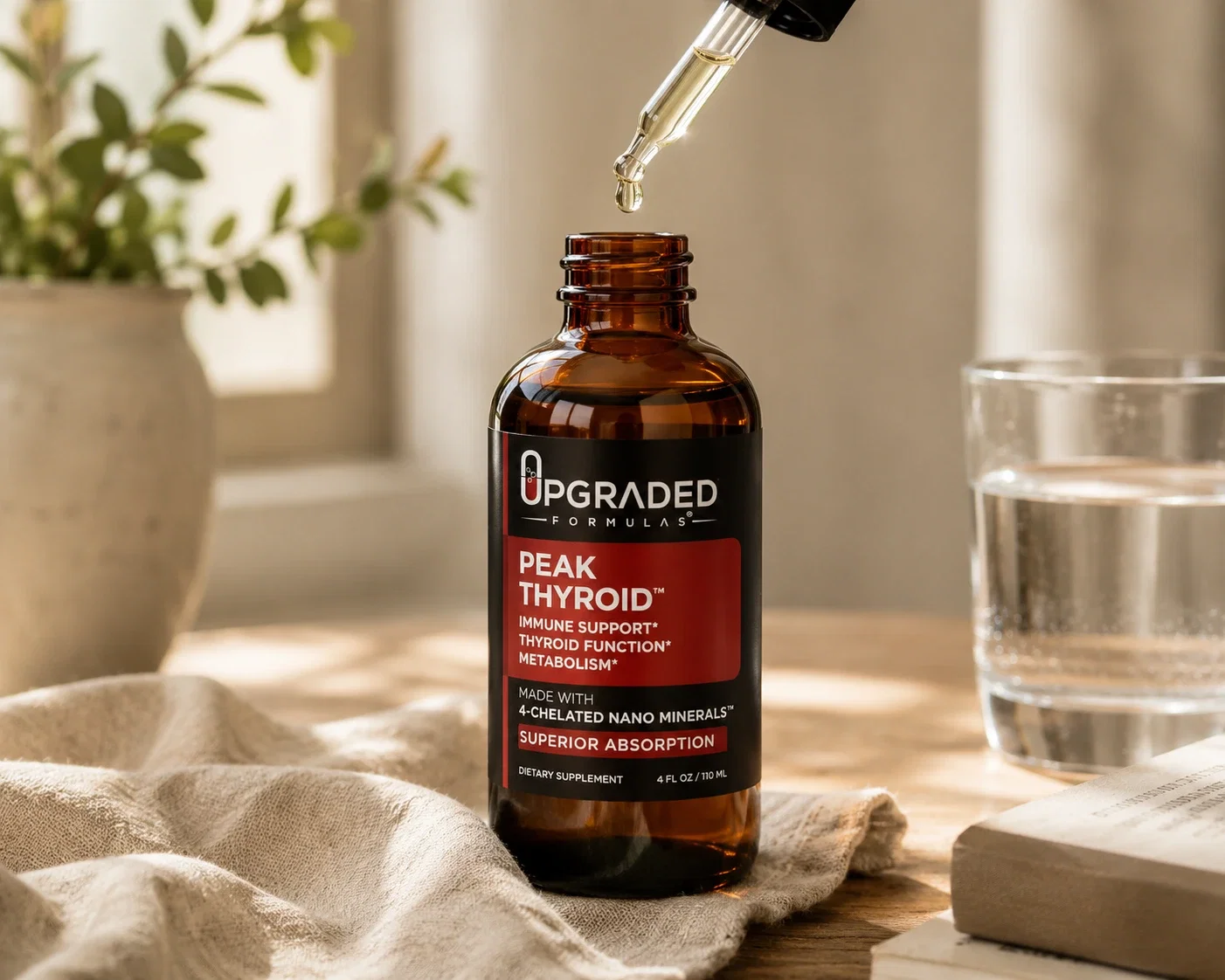
Upgraded Peak Thyroid. Four minerals. Under the tongue. Into your bloodstream in seconds.
Upgraded Peak Thyroid.
Four minerals. Nano-particle liquid drops. Under the tongue. In your bloodstream in seconds.
Se
Selenium
So the enzyme that converts T4 into active T3 finally has what it needs to run. Without selenium at the conversion site, the enzyme stalls. T4 accumulates. A thyroid that's producing, and a conversion line that's stopped.
Zn
Zinc
So your cells can actually receive the T3 signal once it's produced. The hormone can be present and your cells still won't hear it without zinc. It's the receiver. The mineral most thyroid protocols forget.
I
Iodine
The structural building block your thyroid cannot make hormones without. Not in excess. In the precise amount the conversion system needs to function.
Cu
Copper
The regulator. Keeps zinc in balance. Keeps the mineral stack working the way it was designed to. The ingredient most thyroid protocols leave out — the reason most thyroid stacks quietly fail.
The same four things you already believed in, and already took in the past. It is just finally in a form that works.
Here is what happens when the minerals actually arrive.
Rebecca had been building her own thyroid stack for seven months. Selenomethionine 200mcg. Zinc picolinate 30mg. Lugol's iodine. Copper. She'd read every thread, cross-referenced every study. Her free T3 hadn't moved in two retests. She was still waking up at night, still crashing by 2 p.m., still losing hair every morning.
Day five on Peak Thyroid she slept through the night. Not better sleep. Through. She woke up and lay there for a moment because something was wrong and it took her a full minute to realize what it was.
Nothing was wrong. She had just slept.
By week three her free T3 had moved from 2.1 to 2.8. By week six she had lost nine pounds without changing a single thing about how she ate. Her husband asked if her doctor had adjusted her medication. She told him she hadn't seen her doctor. He didn't say anything. He just looked at her the way he used to.
Michelle had been on Synthroid for four years. Her TSH was textbook. Her endocrinologist was satisfied. She was still exhausted by noon, still cold when everyone else was comfortable, still gaining weight on a diet that used to keep her lean. She had stopped telling her doctor because the answer was always the same: your levels look great.
She started Peak Thyroid on a Tuesday. By the following Monday her hands were warm. She noticed it making coffee — she wasn't gripping the mug with both hands the way she had every morning for years.
Week three she cooked a full dinner without sitting down halfway through. Her daughter asked what was different. Michelle said she didn't know yet.
Week seven her free T3 came back at 3.2. It had never been above 2.4 on Synthroid alone. Her endocrinologist asked what she'd changed. She told him. He wrote it down.
"Mom, you look like yourself again."
That's what Donna's daughter told her on a Saturday phone call after she tried Peak Thyroid.
Before, Donna was 47. No diagnosis. TSH 2.6, normal, her doctor had confirmed it twice. But she knew something was wrong the way you know things about your own body that no lab panel can measure. She'd spent months in the thyroid communities. She understood the conversion pathway. She'd built her stack carefully — the right minerals, the right forms, the right doses. She'd taken it for five months without missing a day.
Nothing moved.
Still exhausted by noon. Still foggy on calls she used to run without notes. Still watching the scale go the wrong direction despite doing everything right. Still lying awake wondering if this was just who she was now.
She ordered Peak Thyroid the way you order something when you've stopped believing but can't quite stop trying.
Day eight she slept through her alarm. Twenty minutes late. She lay there for a moment trying to figure out what was wrong.
By the third week the fog had lifted enough that she stopped dreading her morning calls. A few weeks after that, she pulled on a pair of jeans she'd put in the back of the closet fourteen months ago.
They buttoned.
She stood there for a second. Didn't move. Just let it be true.

"She stood there for a second. Didn't move. Just let it be true."
If you've read this far, some part of you recognized yourself in these women.
The protocol you built. The months you gave it. The scale that wouldn't move. The fog that wouldn't lift. The quiet wondering — late at night, lying there — whether this is just who you are now.
I know what that costs. Not just the money, though that's real. I mean what it costs to pick up one more bottle and let yourself believe again. That specific feeling in the supplement aisle, hand on something new, thinking: is this another one that won't work.
I'm not going to promise you it will. I'm not that person and you don't need that from me.
What I'll tell you is this.
You weren't doing it wrong. The research was right. The mechanism was right. The minerals were right. The only thing that failed you was whether they were actually arriving.
That's it. That's the whole problem. And it's the only thing Peak Thyroid changes.
But that one thing changes everything.