After 9 doctors and 12 years of "normal" thyroid labs, this four-mineral liquid finally explained why I felt like a stranger in my own body
And no, my TSH wasn't "fine" — it was missing four minerals American food stopped providing decades ago.

3:14 AM on a Tuesday — that's when I sat down on the bathroom floor and cried about a sweater.
Not a metaphor. A literal cream cashmere sweater that used to be loose and now wouldn't button across the chest. I'd put it on for a work dinner, looked in the mirror, taken it off, and walked into the bathroom with it balled up in my hands. I sat on the cold tile and cried — not because of the sweater, but because the sweater was the thing that finally broke me.
I was 49. I'd been doing everything "right" for nearly a decade. Mediterranean diet. Strength training three times a week. Seven hours of sleep most nights, when I could actually sleep. Functional medicine consultations. A thyroid panel every six months that came back, every single time, with the same annotation in my chart: "within normal range."
I had everything I was supposed to have at 49 — a good marriage, two kids almost grown, a job I'd worked twenty years to build. But for almost twelve years, something had been wrong with me, and I couldn't name it:
I was waking up at 3:17 AM almost every night, heart pounding, mind racing about nothing. I'd gained 27 pounds in five years without changing how I ate. My hair had been falling out for so long the drain in my shower had its own ritual. My eyebrows had thinned to almost nothing on the outer thirds. I'd forget my own children's middle names mid-sentence. I was cold all the time. In July. In Texas.
I'd seen nine different doctors over those twelve years. Every single TSH came back "completely normal." One told me I was "just getting older." Another suggested Lexapro for the anxiety. The last one — the one who finally broke me — said, and I'm quoting verbatim, "Have you considered that maybe you need to accept your body at this age?"
I wasn't crazy. I knew my body. Something was off.
But I had no idea where to look — until a functional medicine practitioner at a women's health summit asked me one question I'd never been asked: "When was the last time anyone tested the four minerals your thyroid is actually built to use?"
This is what she meant. And it changed how I felt in ways I didn't think were possible at this point.
If any of this sounds familiar, this is for you.
Maybe your version looks different. Maybe you're 43, not 49. Maybe you've gained 11 pounds, not 27. Maybe your shower drain is fine but you've quietly started parting your hair on the other side because the part you'd had your whole adult life suddenly looked twice as wide.
You wake up tired. Not "I should've gone to bed earlier" tired — bone-deep tired, the kind that doesn't move when you sleep eight hours, the kind that has you crying in the parking lot at Target by 2 PM on a Wednesday.
You're cold when other people are warm. You sleep with a heated blanket your husband can't be near in the same bed.
You walk into a room and forget why you walked in. Three times the same day.
You step on the scale and the number is different than it was a year ago, even though nothing about how you eat is different. Your favorite jeans fit differently and you can feel it, even when no one else says a word.
Your moods have edges they didn't used to have. Your patience with the people you love is a fraction of what it was.
You've gone to doctors. You've taken the panels. You've been told you're "fine." You've been told it's stress, anxiety, sleep hygiene, perimenopause, "just the age."
And the worst part? You're tired of explaining yourself. You're tired of being told that what you know is happening in your body isn't happening. You've quietly started to wonder if maybe they're right and you're imagining it.
You're not imagining it. And it's not your age.
And here's the part nobody told you.
It's not in your head. It's not "just stress." It's not because you're not trying hard enough. It's not because you're getting older.
The reason you feel this way is that your thyroid — the gland that regulates almost every system in your body, from your metabolism to your mood to your sleep to your hair — has been quietly, slowly starved of the four specific minerals it was designed to use.
Standard bloodwork is excellent at detecting thyroid disease. It's terrible at detecting thyroid dysfunction.
— A reframe most women never hear from conventional medicineA "normal TSH" means your pituitary is shouting at your thyroid at a frequency the lab considers acceptable. It tells you almost nothing about whether your thyroid actually has the raw materials to do its job — and millions of American women in their 40s and 50s don't.
This is why you keep getting told you're "fine" while you feel anything but.
I tried everything before this. Let me save you the time.
Over the twelve years I spent searching, I went through what I now call the "wellness gauntlet." Maybe parts of it sound familiar.
I tried the diets first. Whole30, twice. Keto for nine months. A six-week reset with a naturopath. Intermittent fasting — 16:8, then 18:6, then OMAD. Every protocol got me the same result: tired, hungry, cold, and roughly the same weight by month four.
I tried the supplements. I had a cabinet — actually, two cabinets — full of them. Ashwagandha. Selenium pills. Iodine drops I'd read about on a forum. A multivitamin "for women over 40." A separate B-complex. Magnesium glycinate that I'd been told was "the good kind." I was spending close to $240 a month and had no real idea what was actually working.
I tried the specialists. An endocrinologist who ran the same TSH and said "you're fine." A naturopath who put me on a six-month protocol that didn't move the needle. A functional medicine MD who charged $850 a session and told me I needed to "manage my stress." I had been managing my stress. The stress was the symptom, not the cause.
I tried the hardcore protocols, too — cold plunges, infrared sauna three times a week, hyperbaric chamber sessions a friend swore by. Some of those things helped a little. None of them solved the underlying issue, because I had no idea what the underlying issue actually was.
I was guessing. Constantly, expensively, exhaustingly guessing.
— And nothing about that approach was workingThen a practitioner asked something I'd never been asked.
It was at a small women's health summit in Austin — the kind of weekend conference where you sit through six talks on hormones and one on grounding. I was sitting in the back of the room during a break, drinking lukewarm tea and feeling, frankly, like a fraud. I'd come because I was a health editor, and I was supposed to know things. And I felt worse than I'd felt in my life.
The practitioner was a chemical engineer turned nutritionist named Barton Scott. We got to talking. I mentioned my labs. He listened in that way certain people listen — without interrupting, without trying to fix.
And then he asked me something that stopped me mid-sentence: "When you've had thyroid panels run, have they ever tested the four minerals your thyroid actually needs to make hormone? Not your TSH — the inputs. Zinc, iodine, copper, selenium."
I hadn't. In twelve years of doctors, not one of them had tested any of the four.
He explained why. Your thyroid doesn't make hormone out of nothing. It makes T4 out of iodine and tyrosine. It converts T4 to active T3 using selenium. It needs zinc to bind the hormone and copper to balance the system. Without all four, your TSH can look perfect while your thyroid is functionally starved.
My first reaction was skepticism — if this were true, wouldn't every endocrinologist be testing for it? He laughed, not unkindly. "They're trained to look for disease, not dysfunction. And there's no patentable drug for a mineral deficiency."
I went home that night and started researching. What I found changed how I think about midlife thyroid issues entirely.
Why four minerals matter — and why your supplement probably isn't reaching your cells.
Here's what I learned in the weeks that followed.
Iodine is the backbone of thyroid hormone. T4 (thyroxine) is literally named for its four iodine atoms. Without enough, your thyroid cannot manufacture hormone — full stop. An estimated 30-50% of American women now test as iodine deficient or insufficient, according to NHANES data.
Selenium is the catalyst that converts T4 to T3, the active form of thyroid hormone your cells actually use. Without selenium, you can have plenty of T4 and still feel hypothyroid — because nothing's getting activated.
Zinc regulates the receptor your thyroid hormone has to dock with to do its work. Low zinc means your hormone is circulating but not landing.
Copper balances zinc and supports the enzymes that govern energy production at the cellular level. Without it, the other three are out of tune.
That was the first half of what I learned. The second half was harder to accept: even if you're already taking these minerals in pill form, you're probably absorbing almost none of them.
Most mineral supplements — including the ones I'd had in my cabinet — have a bioavailability rate of 4 to 20%. The mineral particles are too big for your cells to actually take up. The rest passes through you. This isn't fringe science; it's why most multivitamins make for "expensive urine," as functional medicine doctors have been saying for years.
The version Barton had developed solved this with something he called nano-particle technology — minerals reduced to a particle size small enough to enter cells directly, without needing to be digested. Independent testing showed an absorption rate above 99%. Liquid. Tasteless. Two droppers in water, twice a day.
The supplement that doesn't absorb might as well be sugar.
— A line I've thought about a hundred times sinceStandard mineral pill vs. liquid nano-mineral
What changed (and why I almost cried again — for a different reason)
I started two droppers in water, twice a day. Morning with my coffee. Mid-afternoon, around three. That was the whole protocol. No new diet. No new gym. No more cabinets full of guesswork.
Here's what happened over the first ninety days. I'm going to be specific because I think specificity is the only honest way to talk about this.
Week 1. My sleep tracker (an Oura ring I'd been wearing for two years) showed deep sleep go from an average of 38 minutes a night to 64 minutes. I stopped waking up at 3:17 AM. Not "less often." Stopped.
Week 3. My afternoon crash — the one I used to medicate with a second coffee at 2:45 PM — was gone. I worked through 4 PM without thinking about it. The first time I noticed, I had to sit there and process the fact that I'd just worked an entire afternoon.
Week 6. My basal body temperature, which I'd been tracking on a hunch, went from 97.1 to 97.9 — the first time in years it had been in the range thyroid researchers actually consider normal.
Week 10. The cashmere sweater buttoned. I stood in front of the mirror for a long minute and didn't recognize the woman looking back — not because she looked different, but because she looked like me. Like the version of me from before all this started.
Week 12. I'd lost nine pounds. My hair had stopped falling out in the shower. The outer third of my eyebrows had started filling back in — something I'd assumed was just permanently gone.
For the first time in twelve years, I felt like my body was working with me instead of against me.
What to expect over your first few months
I want to be upfront: this isn't overnight. Peak Thyroid didn't fix anything by itself. It gave me the inputs my thyroid had been starved of — and then my body did the rest of the work, which took time.
Based on my experience and the timelines I've heard from other women, here's a reasonable expectation:
Days 1–7. First subtle changes — usually sleep depth, sometimes a softening of the afternoon crash. You may not notice anything yet, and that's normal.
Weeks 2–4. Sleep stabilizes. Anxiety around 3 AM tends to fade. Energy starts to even out across the day rather than spiking and crashing.
Weeks 5–8. Cognitive clarity returns first; brain fog lifts. Body temperature begins to normalize. Many women notice food cravings — particularly sugar and salt — drop off.
Months 3–6. Measurable shifts — weight, hair, eyebrows, mood. This is when the "feeling like myself again" comments start showing up in reviews.
Month 6+. Most women describe it as a new baseline. Not "fixed" — nobody ever is, completely — but functional. Present. Themselves.
And the thing is, none of this is magic. It's the right form of the four minerals your thyroid was built to use, taken consistently. Finally doing what your body actually needed.
How it works (it takes about 15 seconds)
That's it. No protocol, no schedule, no pills to count. The minerals are pre-mixed in optimal ratios so you're not playing pharmacist with your own cabinet anymore.
What you'll notice (click any insight to expand)
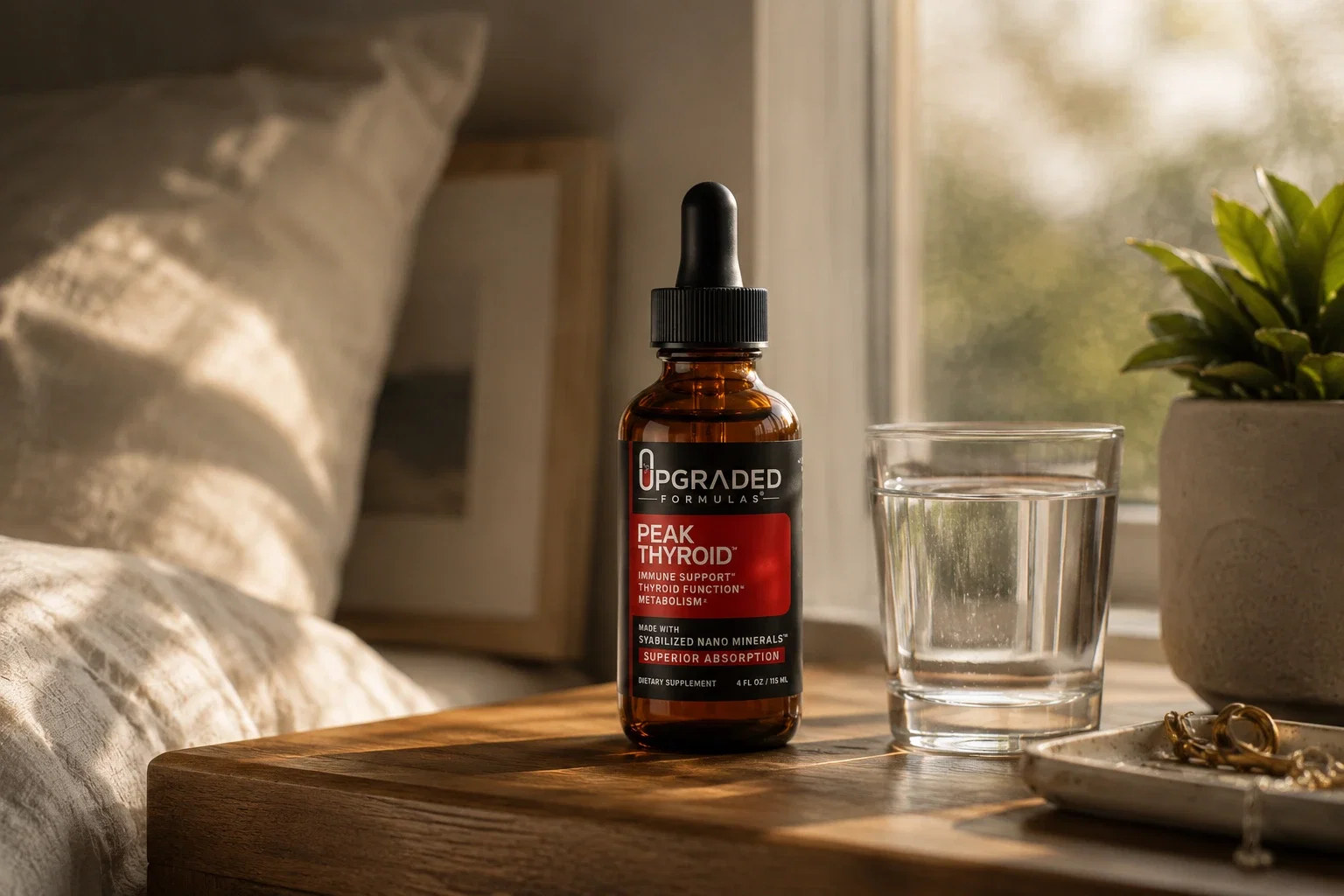
This is exactly what arrives.
A few of the women who got here before you.
How to get Peak Thyroid
Look — I know how this kind of pitch usually goes, and I also know exactly how it feels to spend money on health stuff that doesn't deliver. So here's the deal, plainly.
Peak Thyroid — the four-mineral liquid
- One bottle of Peak Thyroid (118 ml, ~60 servings, ~30 days)
- All four minerals in nano-form: Zinc, Iodine, Copper, Selenium
- Free U.S. shipping on multi-bottle orders
- Detailed daily protocol guide (PDF)
- Access to Upgraded Formulas' customer support team
- 60-day full money-back guarantee — no questions asked
A functional medicine consult: $300–$850
A cabinet of separate mineral supplements: $180–$240/month
Another year of guessing: priceless, in the wrong direction
Our promise: 60 days, no questions asked.
Take Peak Thyroid for the full 60 days. If you don't feel a measurable difference in your sleep, energy, or how you feel in your body, write us one email and we'll refund every dollar. No quiz, no "are you sure," no return shipping hassle. We've shipped tens of thousands of bottles and our refund rate is under 4% — not because we make it hard, but because the product does what it says.
— Barton Scott, FounderQuestions women like you have asked us
One last thing.
I'm not going to tell you Peak Thyroid will change your life. I don't know what's in your body, or how depleted your mineral levels actually are — and neither do you, yet. What I can tell you is what it did for me: it gave my thyroid the inputs it had been quietly starved of for over a decade, and my body did the rest.
If you've been waking up at 3 AM — if you've been told for years that you're "fine" while you've felt like a stranger in your own body — there's a more efficient way forward than another diet, another consult, another cabinet of supplements you're not sure are doing anything.
You can keep doing what you've been doing. Or you can try the four minerals your thyroid was built to use, in a form your cells can actually absorb, with a 60-day refund if it doesn't move the needle.
I know what I'd choose. I already did.